Three kinds of date you'll find on beer
There is no single format. Craft Beer & Brewing puts it simply: because there are no standards or requirements for showing a beer's age, each brewery uses its own method (Craft Beer & Brewing). Most codes still fall into one of these groups.
Packaged-on (“born on”) dates
This tells you when the beer went into the can or bottle, not when it stops
being good. Firestone Walker, for example, prints the packaging date as
month/day/year followed by a time, such as 1/1/23 23:40, on
the bottom of cans or on the bottle label
(Firestone Walker).
On its own, a packaged-on date is only half the answer. You also need to
know how long the brewery expects that beer to stay fresh.
Best-before dates
A best-before date already does the sum for you: it is the brewer's own estimate of when the beer is past its best. In the EU and the UK, a beer under 10% alcohol normally carries one by law (more on that below). The UK government describes a best-before date as being about quality, not safety: after it, food is usually safe to eat but may not be at the same quality (GOV.UK).
Day-of-year (Julian) codes
Some brewers print the day of the year as a three-digit number between
001 and 366, often inside a longer code that can
also hold the year, the time, and sometimes a tank or batch number
(Craft Beer & Brewing).
Where the day number sits in the code, and how the year is shown, is up to
the brewery.
A fourth kind is meant for the trade rather than for you. The US Alcohol and Tobacco Tax and Trade Bureau (TTB) notes that some brewers give their products a coded “pull date” so that wholesalers can take stale beer off the market (TTB Ruling 2017-2). If a code makes no sense as a date, it may be one of these.
How to read a beer date code, step by step
1. Find the code
Turn the can over and check the base, or look over the bottle label, including the back. Firestone Walker's page names both places. Ignore the barcode: on a can of beer, as on most groceries, it identifies the product rather than the batch. Our guide to checking an expiration date with a barcode explains why.
2. Work out which kind it is
- Slashes or a month name, such as
06/15/26or15 JUN 2026: a calendar date. Look for a word in front of it, like “packaged”, “PKG”, “canned on” or “best before”. - A run of three to five digits with no separators, such as
1746: possibly a day-of-year code. - Letters mixed with digits and no obvious date: probably a batch or pull code. Ask the brewery.
Watch the order. A US brewery writing month/day/year and a European one writing day/month/year can print the same digits for different days.
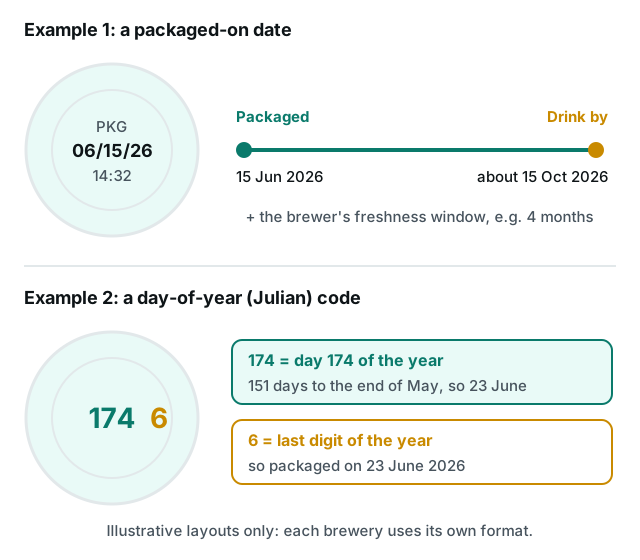
3. Convert a day-of-year code
Take the three-digit day number and find its month in the table below. In
the example 1746, if the brewery puts the day first and the
last digit of the year after it, 174 is the 174th day. January to May
add up to 151 days, so day 174 is 23 June, and the 6 points to
2026. Check the brewery's own explanation before trusting that split.
| Month | Day numbers (non-leap year) |
|---|---|
| January | 001–031 |
| February | 032–059 |
| March | 060–090 |
| April | 091–120 |
| May | 121–151 |
| June | 152–181 |
| July | 182–212 |
| August | 213–243 |
| September | 244–273 |
| October | 274–304 |
| November | 305–334 |
| December | 335–365 |
In a leap year, 29 February is day 060, so every date from 1 March onwards has a number one higher than in the table.
4. Add the brewery's freshness window
Once you have the packaging date, look up how long that brewery says its beer stays fresh, and add it. That gives you a drink-by date. If the brewery doesn't publish a window or explain its code, its FAQ page or customer service is the place to ask; give them the full code and the name of the beer.
Why every brewery prints it differently
In the US, dating beer is the brewer's choice. TTB's ruling on freshness dating describes brewers who put a “freshness date” on their beer so shoppers can judge it, and others who use coded pull dates for wholesalers. It sets conditions for returning stale beer, such as markings on the container that match the date, but it doesn't require a date (TTB).
The EU's food information regulation, which the UK kept after leaving the EU, lists the date of minimum durability or a “use by” date among the mandatory details for food (Regulation (EU) No 1169/2011, Article 9). Its Annex X exempts “beverages containing 10 % or more by volume of alcohol”, so a strong beer can go without one, while a beer under 10% is not covered by that exemption. The same annex says the date is written as “Best before …” when it includes the day, or “Best before end …” otherwise, with day, month and year in that order and in uncoded form (Annex X). So on a beer under 10% sold in the EU or the UK, the best-before date is the one to read.
Other countries have their own rules, so on imported beer, read the words next to the date as well as the digits.
How long does beer stay fresh after packaging?
It depends on the beer and the brewery, which is why the brewery's own
figure matters. Firestone Walker says its lagers and stouts stay fresh for
six months, and hop-forward beers such as Mind Haze and Hopnosis for four
months. So a hop-forward Firestone Walker beer stamped
1/1/23 23:40 is at its best until about the start of May 2023.
Storage matters too. The same page recommends keeping beer for a short time in a dark, cool place, ideally the fridge, away from heat and light. Firestone Walker's sensory analyst adds that pathogens can't live in beer, so from a health standpoint it doesn't go bad; instead it goes stale as it oxidises and the hops fade (Firestone Walker). That is one brewery talking about its own beer, so for anything else, the brewery's advice and the label come first.
Is there a beer code date app?
An app can help with the part that comes after the decoding: remembering. Xpiry doesn't decode brewery codes and doesn't read dates from barcodes. What it does is keep the drink-by date you worked out. Xpiry is an expiry date tracker for Android: scan the can's barcode to fill in the product quickly, enter the drink-by date, and choose how early you want a reminder.
Worked out when a few cans should be finished? Xpiry keeps those dates in one list sorted by date and sends a reminder before each one arrives, so the older beer gets drunk first.
Beer sits alongside everything else in the fridge and pantry; our food expiration tracker page shows how that works, and what the date labels on other food mean.
FAQ
What do the numbers on the bottom of a beer can mean?
Usually a packaged-on date, a best-before date or a day-of-year code, sometimes followed by a time or a batch number. The format is the brewery's choice, so check its website if it isn't clear.
What is a Julian date on beer?
The day of the year as a number from 001 to 366. 001 is 1 January, and in a non-leap year 365 is 31 December. It tells you when the beer was packaged, not when it goes stale.
Does beer expire?
It goes past its best. A best-before date marks quality, not safety, and Firestone Walker describes old beer as stale rather than unsafe, and gives its hop-forward beers a shorter window than its lagers and stouts.
How long is beer good after the packaged-on date?
As long as the brewery says. Firestone Walker gives four months for its hop-forward beers and six months for lagers and stouts; other breweries publish their own figures.
Sources
- TTB, TTB Ruling 2017-2: Freshness Dating and Allowable Returns of Malt Beverage Products
- legislation.gov.uk, Regulation (EU) No 1169/2011, Annex X: Date of minimum durability
- legislation.gov.uk, Regulation (EU) No 1169/2011, Article 9: List of mandatory particulars
- GOV.UK, Understanding food labelling: Best before and use-by dates
- Firestone Walker Brewing Company, Does Beer Expire?
- Craft Beer & Brewing, Is This Beer Fresh?