How long can frozen food sit out at room temperature?
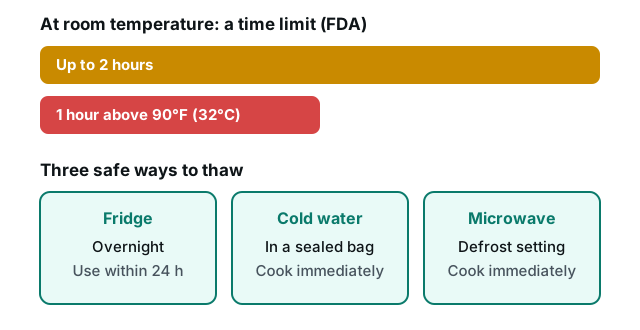
Two hours at most, and one hour on a hot day. The FDA's advice is not to leave meat, poultry, seafood, eggs or other foods that need refrigeration out for more than two hours, and to cut that to one hour when the air temperature is above 90°F (FDA). The same limits apply to leftovers and take-away food.
Those limits are written for perishable food in general. The FDA does not publish a separate, longer figure for a frozen pack, and on thawing it is blunt: “Never thaw food at room temperature, such as on the counter top” (FDA, Safe Food Handling). So the practical answer to how long frozen food can be left out is the same two hours, and less is better.
The same clock runs on the way home from the shop. The FDA says to refrigerate or freeze perishables within two hours of buying them, or within one hour if it is hotter than 90°F outside.
Why the counter is a poor place to thaw
Freezing pauses bacteria; it does not remove them. In the FDA's words, freezing stops bacteria from growing but does not kill most of them. Once the food warms up, they can start multiplying again.
Food agencies describe a temperature range where that growth is fast. Health Canada puts this danger zone between 4°C (40°F) and 60°C (140°F) (Health Canada). The UK's Food Standards Agency uses 8°C to 63°C (Food Standards Agency). The figures differ a little, but a kitchen counter sits inside both ranges, and a fridge sits below them. That is the whole reason the agencies send you to the fridge.
The Food Standards Agency also asks you to check that the centre, the densest part, has fully thawed before cooking. A piece that is still frozen in the middle may cook unevenly, which can let bacteria survive.
Three safe ways to thaw frozen food
The FDA lists three safe ways to defrost food: in the refrigerator, in cold water, or in the microwave. Health Canada shows the same three in its short video on thawing frozen meat.
In the fridge
The slow method, and the one the Food Standards Agency calls the safest: in the fridge overnight, in a container big enough to catch any drips. It needs planning, because a large item will not be ready the same day. The agency says to use food within 24 hours of it being fully defrosted.
In cold water
Faster than the fridge. Health Canada's video shows the meat in a sealed bag, in a sink filled with cold water. The FDA adds one condition: food thawed in cold water should be cooked immediately.
In the microwave
The quickest. The Food Standards Agency suggests the defrost setting, used directly before cooking, and the FDA again says to cook the food immediately afterwards. It is a method for tonight's dinner, not for tomorrow's.
Many packs carry their own defrosting instructions, and some frozen foods are meant to be cooked from frozen. Where the label says something specific, follow the label.
Frozen food left out by accident: keep, cook or bin?
A bag forgotten on the counter, shopping left in the car, a freezer door that did not close. Official advice does not cover each case by name, but the FDA's rules for room temperature and for power cuts give you something to decide with.
| What you find | What the FDA says |
|---|---|
| Still has ice crystals, or a thermometer reads 40°F (4°C) or below | Can be refrozen or cooked (its advice after a power cut) |
| Thawed and out for under two hours (one hour above 90°F) | Inside the limit: cook it or put it in the fridge now |
| Out for longer than that | Past the limit the FDA sets for perishable food |
| Meat, poultry, fish, milk, eggs or leftovers above 40°F for four hours or more | Discard |
One thing the FDA is clear about: do not rely on appearance or odour to judge it. Food that has been warm for too long can look and smell fine. If you cannot tell how long it was out, you cannot apply the limit, and that is a reason to throw it away, not to guess.
Can you refreeze food that has thawed?
It depends on how warm it got. After a power cut, the FDA says food that still contains ice crystals, or is at 40°F or below, can be refrozen or cooked. That is a temperature test, not a time test, so a thermometer helps more than a guess.
Cooking changes the picture. The Food Standards Agency says cooked food can be frozen again, but should then be reheated only once. So raw mince that was defrosted in the fridge and cooked into a sauce can go back in the freezer as sauce. How long it keeps there is covered in our guide to how long frozen food is good for.
After thawing, the date changes
In the freezer, time barely matters for safety. Out of it, the food is perishable again and the useful date is now very close: the day you plan to cook it, or the 24 hours the Food Standards Agency gives for defrosted food. That is easy to lose track of when the pack still shows a best-before date months away.
Xpiry is an expiry date tracker for Android. When you move something from the freezer to the fridge, change its storage place and set the date to the day you want to use it by, and Xpiry reminds you before that day arrives. It does not decide what is safe to eat; it remembers the date you chose.
Thawing something for later in the week? Add it to Xpiry with a use-by date and a reminder, so it does not sit in the fridge past its day.
The food expiration tracker page shows how the fridge, freezer and pantry fit in one list.
FAQ
Can I thaw meat on the counter overnight?
The FDA says not to thaw food at room temperature. Overnight is also far beyond its two-hour limit for perishable food. Use the fridge overnight instead.
Frozen food sat in the car for a few hours. Is it still good?
The FDA's limit is two hours from purchase to fridge or freezer, and one hour above 90°F. If it still has ice crystals, its power-cut advice says it can be refrozen or cooked. If it thawed and you do not know for how long, do not judge it by look or smell.
How long does thawed food keep in the fridge?
The Food Standards Agency says to use food within 24 hours of it being fully defrosted. Food thawed in cold water or in the microwave should be cooked immediately, according to the FDA.
Is the limit different in the UK?
The wording is. The Food Standards Agency says chilled food should be out of the fridge for the shortest time possible during preparation, with a maximum of four hours. The FDA's figure is two hours. Both agree on defrosting in the fridge.
Does cooking make food safe after it sat out too long?
The sources used here do not say that it does, and the FDA's advice for perishable food kept above 40°F for four hours or more is to discard it, not to cook it.
Sources
- FDA, Are You Storing Food Safely?
- FDA, Safe Food Handling
- Food Standards Agency, How to chill, freeze and defrost food safely
- Health Canada, Safe food storage
- Health Canada, Best way to thaw frozen meat